
The Corner Office: How Top CEOs Made It and How You Can Too by Adam Bryant
Posted on August 4, 2014 Leave a Comment
This book was recommended to me by an amazing lady (thanks Sue!) so I thought I’d give it a whirl.
I’m so glad I did, because it’s full of tips for managers at any level (not just CEO’s) and it’s given me these two fabulous analogies to add to my list.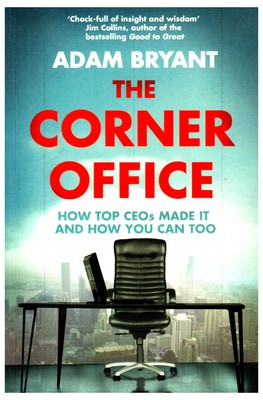
1. Be a coach, not a critic
2. Hire Tiggers, not Eeyores
I love number one and find it such a useful theme/reminder for me. It also ties in beautifully with another statement I recently read on a management document: “I coach them through the game; I don’t play it for them. The coach doesn’t play on the field.”
Number two just makes me smile – I bet we’ve all worked with an Eeyore or two before!
The book follows the rough format of interviews with different/famous CEO’s (though the chapters are on themes not people/interviews) and what can be learnt from all of them. I was mostly drawn to the people management tips, but there is also wisdom on time management, measurement, career advice and delivering results.
One of my other favourite tips was around the ‘rule of three’ in terms of being a great manager; competence, confidence and caring. Such a simple mantra to keep in mind – I agree with the author that if you get these three right then you’ll be winning!
Here’s the explanation
1. Competence
“The first is competence—just being good at what you do, what ever it is, and focusing on the job you have, not on the job you think you want to have.”
2. Confidence
“The second one is confidence. People want to know what you think. So you have to have enough desirable self-confidence to articulate a point of view.”
3. Caring
“The third thing is caring. Nothing today is about one individual. This is all about the team, and in the end, this is about giving a damn about your customers, your company, the people..”
7 more tips from the Corner Office
(headings = mine, quotes = directly from the book)
1. Ask better questions
“Though CEOs are paid to have answers, their greatest contribution to their organizations may be asking the right questions—a skill that starts with passionate curiosity.”
2. Get out of your comfort zone
“I say yes to things that I really don’t want to do, or I get involved in things that are difficult for me to be involved in, for what ever reason. (Steve Hannah, CEO of The Onion)
3. Hire Tiggers
Mindy Grossman of HSN uses Winnie-the-Pooh as a reference point. She says she likes to hire people who are Tiggers, not Eeyores.
4. Be a coach
Here’s another approach: Be a coach, not a critic.
5. Focus on improvement
And if I spend my time focusing on everything that’s bad, I’ll get nothing done. Or I could say, what are really the best things about the people I have? What makes them great, and how can I really improve them one or two notches? And if I spend my time on that, then I’ll have a great organization.
6. Tell people when they’ve peed on the carpet
Carol Bartz of Yahoo prefers the “puppy theory” feedback.
“When the puppy pees on the carpet, you say something right then because you don’t say six months later, ‘Remember that day, January twelfth, when you peed on the carpet?’
7. Appreciate and praise wherever you can
“People leave companies for two reasons. One, they don’t feel appreciated. And two, they don’t get along with their boss.”
Grab your own tips and the book over here on Amazon
Happy reading,
C x
Growth Hacking Techniques, Disruptive Technology – How 40 Companies Made It BIG, by Robert Peters
Posted on July 28, 2014 Leave a Comment
This is my second book on growth hacking (go me!) and I’m feeling like my understanding of this subject has definitely improved. What this book did well was the examples – loads of  them.
them.
A few thoughts if you’re thinking of getting this one:
- I thought there would be much more ‘explanation’ in the book. There isn’t. It’s really one chapter on the mindset and then the rest is all examples.
- It’s also quite short. I read 50% of it in a lunch-break. This might be a bonus for you until you realise that the price tag is still similar to other longer books ($10 on kindle).
Those two minor-moans aside, I really did enjoy all the case studies of strategies that ‘real’ companies have implemented.
The key themes for me across the companies were; sharing, referrals, building the marketing into the product design and making it exclusive e.g. beta invites.
For those wondering what (or who) a growth hacker is… Are they coders? Are they marketers? An amazing hybrid? According to the author they could be brilliant at both, but that as he rightly says these people ‘are about as common as mythical unicorns!”
5 tips on adopting a growth hacker mindset
(headings = mine, quotes directly from the book)
1. Consider a freemium model to entice the early adopters
“… Evernote works on a “freemium” model. Users receive access to free, basic service at sign up with an option to upgrade, with more features and storage space.”
2. Get obsessed with metrics and details
“Every two weeks the company tests its site design, user experience, and other features with A/B testing through Kissmetrics.” Read More
Power Cues: The Subtle Science of Leading Groups, Persuading Others, and Maximizing Your Personal Impact by Nick Morgan
Posted on July 2, 2014 Leave a Comment
Let’s talk about power cues.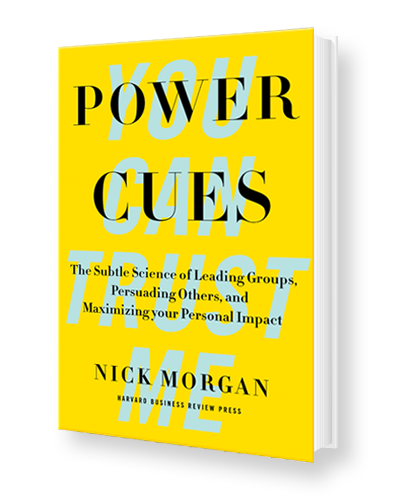
Which really means – let’s talk about the sort of advice that you can stash in your wonder-woman-at-work file. (or superman file if you prefer)
Things like this: when feeling unconfident, duck into the bathroom or an empty meeting room and adopt a super woman pose (hands on hips, feet wide apart) for ten minutes. Do this and you’ll start to automatically feel more confident.
Sounds a little nutz, but if you don’t believe me then watch this Ted video by Amy Cuddy.
I digress – back to this book on seven power cues. Adopt them and (according to the author) become a become the type of leader that walks into a room and charms the pants off everyone.
To avoid any suspense – here’s the seven cues: self awareness, non-verbal communication, unconcious messages, your voice, signals you send, intiutition (unconcious mind) and telling stories.
And a few of my favourite tips from the book…
7 tips on ramping up your power
(headings = mine, quotes all directly from the book)
1. Get focused baby
“…charisma is quite simple. It’s focused emotion.”
2. Faking it really does work
“In other words, sometimes it does help to fake it until you make it! Or more precisely, you can work from either the inside out, that is, from emotion to gesture, or the outside in, that is, from gesture to emotion. The two approaches complement one another.”
3. Tell stories
“Great leaders are great storytellers. These leaders know that they must tell powerful stories to engage and enlist their followers.”
4. Use gestures – and help your brain (seriously)
“But Goldin-Meadow is honing in on a further aspect of gesture and speech, one that has fascinating implications for why we gesture. As she puts it, ‘If you gesture, it lightens your cognitive load.’ By that, she means that it takes less mental effort to speak while gesturing. ” Read More
The Obstacle is the Way, by Ryan Holiday
Posted on June 30, 2014 Leave a Comment
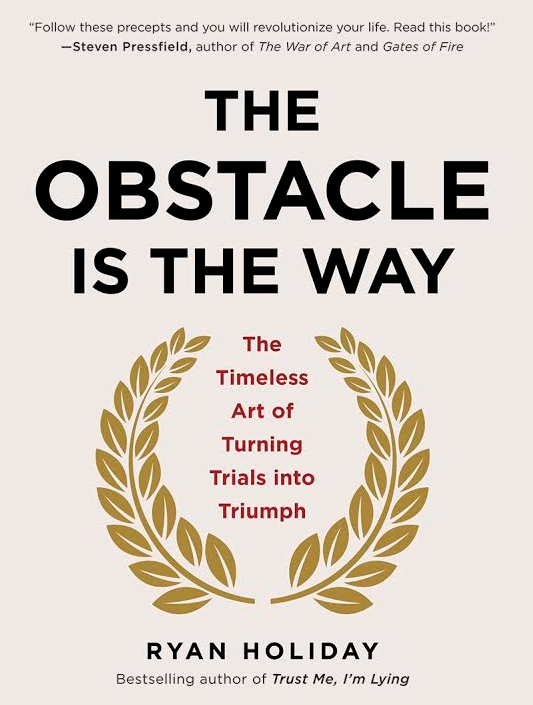 Definitely not a marketing book, but I have read Ryan’s other two books (here and here) so I thought I’d finish out the set.
This one is much more self-helpy, but in a businessey sort of way. (yes those are words, on my blog they are anyway).
What I love about Ryan’s work is how much research he does. There’s all sorts of interesting examples from historical wars, famous figures…
For instance – when talking about a study of battles – “In only six of the 280 campaigns was the decisive victory a result of a direct attack on the enemy’s main army.” (Who knew, we have been misguided by the movies!)
The basic jist of this book, for me, was this: obstacles = opportunities.
Well worth a read if you like the ‘better yourself’ style of book, but without any of the New Age language (there’s nothing about looking in a mirror and repeating affirmations).
Here’s 7 tips from Ryan on turning obstacles into opportunities
(headings = mine, all quotes directly from the book)
1. Make like Rockfeller
“He was inclined to see the opportunity in every disaster.”
2. Don’t panic, instead…
“focus on what can be controlled” Read More
A Technique for Producing Ideas (Advertising Age Classics Library) by James Webb Young
Posted on May 30, 2014 Leave a Comment
Quite possibly the oldest marketing/advertising book that I’ve read so far (ding, dong!) this baby was first published in 1965. 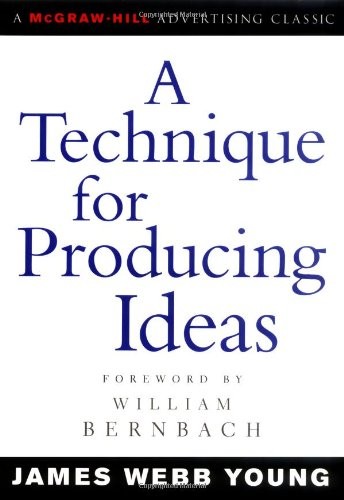
I got onto it via a blog that recommended it as a complete classic and an excellent example of how to produce ideas.
Being an idea-junkie myself – I pounced. I often find that while ideas, innovation and change are valued in business, we rarely examine how these ideas come about. Instead we label someone as being great at coming up with ideas, or being crap. In reality there’s a process for coming up with ideas, and if you work at it, you’ll get it.
If you like this idea-making side of creativity then I also recommend giving Hey Whipple a read – another fab creative book and one that describes a creative process that is very, very similar to the one below.
Enough from me…
Summary – five step technique for producing ideas!
(headings = mine, quotes = directly from the book)
Firstly understand that an idea is just a combination of the old
“The first of these has already been touched upon in the quotation from Pareto: namely, that an idea is nothing more nor less than a new combination of old elements.”
(and before you launch into the five steps I would add that you need to know what problem you are trying to solve – what is your goal?) Read More
Confessions of a Public Speaker by Scott Berkun
Posted on May 26, 2014 1 Comment
I read this before a presentation I had to give at work – and I giggled throughout! 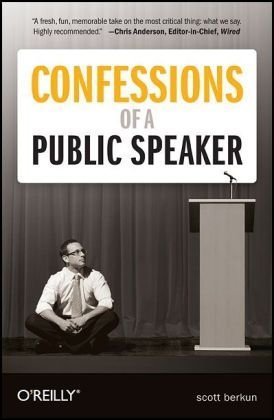
Thought it was pretty rare to find a book on public speaking that’s funny (rather than fear inducing) but this one delivers.
If you buy it I suggest skipping right to the back appendix where you can read about the ‘worst’ stories of public speaking. The idea being that you sure can’t do any worse that these people! Think stories like waking up hungover before your preso and accidentally smoking a joint, or even going to show the audience your new website and instead popping up a website full of anal sex – yes these all happened!
Anywho, you’ll feel better that
- Your preso can’t be any worse than these stories
- You can still go back and read the rest of the book for some useful tips.
Loved the use of humor in this and the realistic advice – aka the butterflies won’t go away, you just have to learn to tame them. I would have loved to see more on the use of body language, gestures, pumping up the enthusiasm (actual delivery) but it doesn’t delve much into this.
Here’s a few fabulous speaking tips from Scott
(headings = mine, quotes directly from the book)
1. Realise it’s not as important as you think
“The secret to coping with these events is to realize everyone forgets about them after they happen — except for one person: me. No one else really cares that much.”
2. You must forget about being perfect
“I know I make small mistakes all the time. There’s no way not to. Besides, when performing, perfection is boring.” Read More
 The Marketer's Bookshelf
Recent Comments