
I’m Feeling Lucky: The Confessions of Google Employee Number 59 by Douglas Edwards
Posted on October 29, 2013 Leave a Comment
This isn’t a marketing manual by any stretch, but an inside look at google from a marketers point of view – I found it 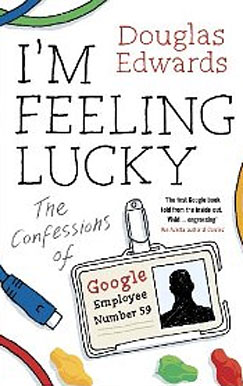 fascinating.
Douglas Edwards was (as you may have guessed) Google Employee Number 59 and he writes about the growth of the company from only a few marketing/PR staff and no outside agency – to the mammoth beast that it is today. Douglas lasted five and a half years at google and he provides a fly in the wall insight into what the company was like in it’s early days.
Even though the book is more of a life story than a manual – there’s still some lessons to learn! Here’s a few I picked out.
Marketing snippets from Google Employee Number 59
(headings = my comments, all quotes directly from the book)
1. A great idea for a Friday meeting
“TGIF was an all-company affair at which Larry and Sergey recounted the wins of the previous week as we sipped beer and chewed food on skewers.”
2. Make it simple
“Nonfunctionality is a feature,” he instructed me. “We don’t need to increase page views by adding products.” Read More
Never Eat Alone: And Other Secrets to Success, One Relationship at a Time by Keith Ferrazzi, Tahl Raz
Posted on October 21, 2013 Leave a Comment
So here’s 10 bond-more-with-people tips from Never Eat Alone
The 22 Immutable Laws of Branding by Al Ries, Laura Ries
Posted on October 6, 2013 Leave a Comment
This book is known as a branding classic (first published in 1993) so I shouldn’t have been surprised to find that much of the  advice and lessons are still incredibly relevant.
If you’re about to name a product or business then there’s some super useful stuff in this book for you. In particular I found the comments on sub branding and company branding pretty insightful. According to the authors, “Unless there are compelling reasons to do otherwise, the best branding strategy should be to use the company name as the brand name.”
Here’s 6 more brand building tips from the book
1. Be first
“So what do you do if you weren’t the first in a category? Quite often you can create a new category by simply narrowing your focus.”
2. Narrow your focus
“A brand becomes stronger when you narrow its focus.” (the authors call this the law of contraction)
3. PR = brand building.
“…over the past two decades, public relations has eclipsed advertising as the most effective force in branding.” Read More
Managing Up: 59 Ways to Build a Career-Advancing Relationship with Your Boss by Michael S. Dobson
Posted on October 3, 2013 Leave a Comment
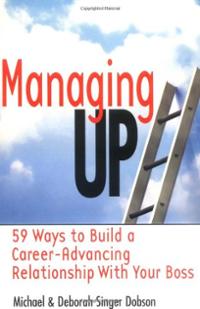
Eight quotes on managing your career/boss
- “…compensate for your boss’s weak points. Everyone has them.”
- “The number 1 duty of every employee is to have a successful relationship with the boss.”
- “DBMP-BMA” rule: “Don’t bring me problems, bring me answers.”
- “Just remember this: Management has to have a role in any major decision or project, and if you don’t give them one, they’ll take one.”
- “Don’t always wait to be asked or ordered; volunteer to help out, and then make sure all the credit goes to your boss.”
- “…one of the most powerful tools available to you in advancing your relationship with your boss is to give credit and praise generously.
- “Another strategy is recommended by noted self-esteem expert Jack Canfield. He suggests you keep a Victory Log of all your everyday successes, no matter how small.”
- “Job titles and money tend to come after the fact to the people who’ve already proven themselves.”
How to Write Perfect Press Releases by Steven Lewis
Posted on September 27, 2013 Leave a Comment
Some experts might argue that the press release is on it’s way to the graveyard named: old school marketing and pr tactics that 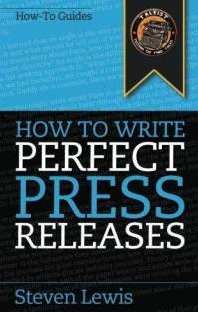 don’t work anymore. (Too spammy, one on one pitch is better etc).
However, in New Zealand at least, I can attest to the fact that when used correctly – it still works and is a useful tool for delivering information.
Here’s six useful tips from the book on the art of writing releases
1. Remember journalists are about story ideas – not favours
“what journalists are looking for — all the time — is good story ideas. They’re not looking for ways they can do you a favour and promote you or your service/product. But they do understand the trade: a good story for them to write in return for a promotional opportunity.”
2. You need an angle
“…angle is the way you approach a story to decide what should be in it and what should be left out.”
3. Get a good lead
“Five years ago Steve Jobs had an idea…” is the start of a linear story. What Steve Jobs was doing five years ago is not the lead and it doesn’t help with our “now” factor. “Today Apple launched the iPod, the most advanced MP3 player on the market and the future of music sales” is the lead.
4. Think about their readership
“Once you know who a publication’s readers are you can start getting into their heads and asking what you can tell them — through the journalist — that will be interesting to them and useful to you.”
5. Ponder these three questions – before you start writing
“Why is this a great story for this publication? Why am I the right person to tell it? If the reader were to take just one thing from this story, what would I want it to be?”
6. Do not ring a journalist just to ask if your release arrived
“As a journalist I hate it when PR people phone me to ask if I received their media release. Email is almost 100 per cent reliable so it’s a fair assumption that I did get it; and, if I didn’t contact you, I’m not interested.”
Interested in more on writing releases? Get it here.
Happy reading,
C x
Growth Hacker Marketing, by Ryan Holiday
Posted on September 16, 2013 Leave a Comment
I was absolutely dying to read this! Pre-ordered it on Amazon and then sat waiting on launch day checking and re-checking my  kindle expectantly.
Of course I felt silly when I realised that NZ is a day ahead so launch day was actually… not until tomorrow.
Moving on…
I thought Ryan’s first book was a masterpiece (whether I agree with his methods/ethics is another story) in terms of how the media machine in America is working and how easily it can be manipulated by the likes of… well Ryan!
Growth Hacker Marketing is quite a different topic and style… much less controversial (a sneaky part of me would also say less enjoyable). Think less crazy media stunts and more… Seth Godinisms (my word) e.g. marketing is the product.
My top five takeaways with matching quotes
1. Start with the product
“You know what the single worst marketing decision you can make is? Starting with a product nobody wants.”
2. Growth hacking can be simple
Ryan gives the example of Hotmail who used Growth Marketing way back when… with the simplest idea ever (well probably not at the time)
“So put ‘P.S.: I love you. Get your free e-mail at Hotmail’ at the bottom of every email.”
3. It’s not about your tv ad or your billboard
“A growth hacker doesn’t see marketing as something one does, but rather as something one builds into the product.” Read More
 The Marketer's Bookshelf
Recent Comments